
A No Flow alarm can interrupt a feeding and leave you wondering what went wrong. But a No Flow alarm does not necessarily mean there’s a problem with your Infinity or Infinity Orange enteral feeding pump.
The pump is one part of a larger feeding system that includes the formula, feeding bag, tubing, and patient’s feeding tube. When the pump sounds a No Flow alarm, it is alerting you that formula may not be moving through the system as expected.
Understanding how formula moves through the feeding system, and knowing what to check along the way, can help you prevent and troubleshoot common No Flow alarms.
Think of your feeding system as a nutrition highway
Think of your Infinity pump as a traffic monitor on a nutrition highway. Formula travels along a route:
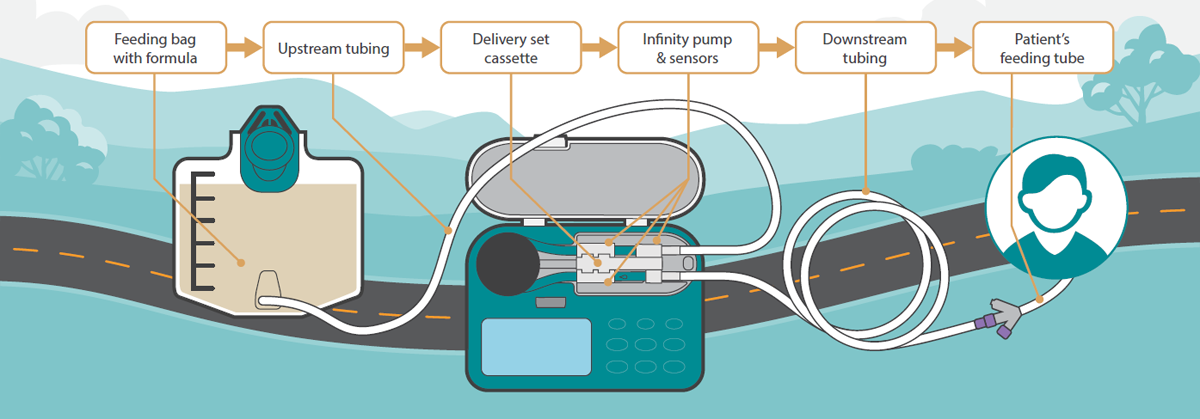
Just like traffic needs a clear road, formula needs a clear and unobstructed path from the feeding bag to the patient. If something slows or stops the formula along that route, the pump may sound a No Flow alarm.
The important thing to remember is: The pump isn’t necessarily creating the traffic jam. It’s alerting you that formula has slowed or stopped somewhere along the route.
So, what can you do to help keep formula moving?
1. Maintain the feeding set
Your feeding set is where the journey begins. Proper feeding set use and care can help keep feedings on schedule.
Help keep feeds flowing
- Replace the feeding bag every 24 hours.
- Rinse the feeding set (bag and tubing) between feedings as directed by your healthcare provider.
- Follow the formula manufacturer’s recommended hang time.
- Keep the cap on when the bag is not in use.
- Avoid storing feeding bags in high heat or direct sunlight.
- Feeding bags are designed for up to 24 hours of use.
If you’re experiencing a No Flow alarm
Start by checking the feeding bag:
- Has the bag been in use for more than 24 hours?
- Has the formula exceeded the manufacturer’s recommended hang time?
- Is formula able to move freely?
2. Load the right cargo
What’s traveling down the nutrition highway matters.
Properly prepared formula helps keep traffic moving smoothly. Use only formulas prescribed by your medical team and fully mix formula before beginning a feeding. Make sure formula is smooth and free from chunks or particulates.
If you use a blenderized formula, follow the formula manufacturer’s recommendations for use with a feeding pump. If formula has been aggressively mixed and contains foam, allow it to sit for 10 to 15 minutes before feeding.
If you’re experiencing a No Flow alarm
Consider what is in the feeding bag and how it was prepared:
- Is the formula completely mixed?
- Are there chunks, particulates, or other material that may not flow smoothly?
- If using a blenderized formula, was it prepared according to the manufacturer’s recommendations?
- Is the product at the appropriate temperature?
If formula is not prepared appropriately or does not flow smoothly, the pump may sound an alarm.
3. Keep the road clear
Formula needs a clear path from the feeding bag to the patient.
Something as simple as kinked or pinched tubing can interfere with formula moving through the system. This can be especially important when the pump is being used in a backpack or other carrying configuration where the tubing may be less visible.
Help keep feeds flowing
Before starting a feeding:
- Keep tubing straight or loosely coiled.
- Check for kinks or pinches.
- Make sure clamps are open.
- Make sure nothing is pressing or sitting on the tubing.
- Make sure the patient’s feeding tube is clear and not clogged.
If you’re experiencing a No Flow alarm
Follow the feeding path from the bag all the way to the patient.
Look for:
- Kinked or pinched tubing
- Closed clamps
- Tubing being compressed or restricted
- An obstruction in the patient’s feeding tube
A No Flow In alarm means the pump has detected a blockage or occlusion in the set between the bag and the pump. A No Flow Out alarm means the pump has detected one between the pump and the patient.
Knowing which alarm you’re seeing can help you focus your check on the right part of the nutrition highway.
4. Prevent traffic buildup
Formula residue can build up in the feeding set over time. When buildup narrows the pathway, formula may have a harder time traveling through the system.
Help keep feeds flowing
- Rinse the bag and tubing between feedings as directed by your healthcare provider.
- Keep the feeding set and tubing free from formula residue and buildup.
If you’re experiencing a No Flow alarm
First, determine if the pump is detecting occlusion in the feeding set or the patient’s feeding tube by disconnecting the set from the patient then run the feeding – be sure to place the end of the feeding set into a container to collect any formula. If the pump runs without alarm, you have identified that the No Flow alarm is occurring because of the patient’s feeding tube. Ensure the tube is not clamped and reach out to your provider for additional directions on how to address the occlusion in the feeding tube.
If the pump still alarms while disconnected from the patient’s feeding tube, inspect the feeding set for formula build up or residue. Remove the set from the pump and clean the cassette. Gently massage the
drop symbol, then manually prime the set until the occlussion is clear and formula moves through the tubing. Replace the set and resume feeding.
Important: Do not use the PRIME key to troubleshoot or resolve a No Flow In or No Flow Out alarm.
5. Help the pump sensors stay clean
Your pump’s sensor area is another important part of keeping feedings flowing.
The sensors help the pump monitor what’s happening within the feeding system. Keeping the sensor area free from formula buildup and debris helps the pump monitor the system as intended.
Help keep feeds flowing
- Keep the sensor area clean and free from buildup or debris.
- Clean the pump cassette receptacle with water and a cotton swab as directed.
- Routinely inspect the pump for visible damage.
If you notice obvious damage, such as a crack in the pump door or housing, contact Moog Customer Support for assistance.
If you’re experiencing a No Flow alarm
Check and clean the pump receptacles around the pressure sensors and inspect the pump door and latch for cracks or damage.
If appropriate after completing the recommended checks, turn the pump off and then back on before resuming the feeding.
Watch this video to see how to properly clean Infinity pumps or read more about cleaning Infinity pumps at home.
Getting a No Flow alarm? Start here.
When a No Flow alarm occurs, remember to look at the entire feeding system, not just the pump. Setup and preparation matter, and reviewing the full system can help identify potential problems.
Before calling for assistance, check:
- Formula: Is the formula prepared and mixed as directed?
- Hang time: Has the formula exceeded the manufacturer’s recommended hang time?
- Tubing: Is the entire tubing path free from kinks, pinches, closed clamps, or anything pressing on it?
- Feeding set: Is there formula residue or buildup that may be restricting flow?
- Sensor area: Is the pump sensor area clean and unobstructed?
- Feeding tube: Is the patient’s feeding tube clear and not clogged?
Remember: A No Flow alarm doesn’t necessarily mean there’s a problem with the pump
The pump is just one part of the feeding system.
A No Flow alarm means the pump senses that formula may not be flowing as expected. Looking at the complete nutrition highway, from the feeding bag to the patient’s feeding tube, can help identify where formula may have slowed or stopped.
Helpful resources
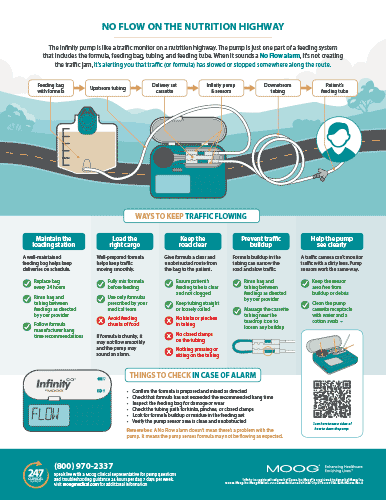
Infinity No Flow Infographic
Use this quick visual guide to better understand the feeding system, ways to help prevent No Flow alarms, and what to check when an alarm occurs.
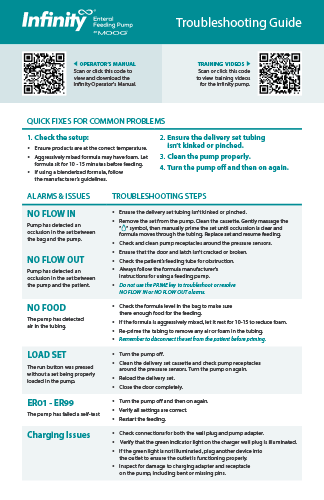
Infinity Troubleshooting Guide (English)
For additional step-by-step troubleshooting guidance for Infinity Enteral Feeding Pump.
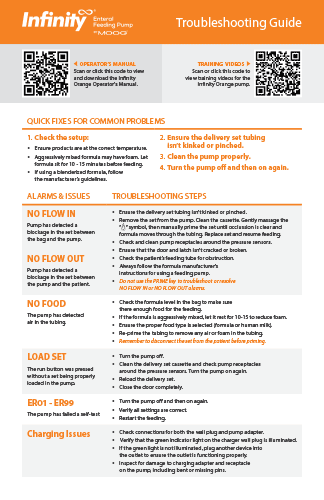
Infinity Orange Troubleshooting Guide (English)
For additional step-by-step troubleshooting guidance for the Infinity Orange Small Volume Enteral Feeding Pump.
Still having problems?
If you continue to experience repeated No Flow alarms after checking the feeding system, we’re here to help.
Speak live with a Moog Clinical Representative for pump questions and troubleshooting guidance 24 hours a day, 7 days a week at (800) 970-2337. Moog’s troubleshooting materials also note that Clinical Support is available in more than 250 languages.
When you call, have details about the alarm you’re seeing and the troubleshooting steps you’ve already tried

Cory Orme
Cory Orme is a Senior Product Marketing Manager at Moog Medical, specializing in go-to-market strategy, product positioning, and data-driven marketing for healthcare solutions. He holds a Marketing degree from Weber State University and is passionate about aligning customer and patient needs with our products. Cory in his free time enjoys watching/playing soccer and ultimate frisbee.